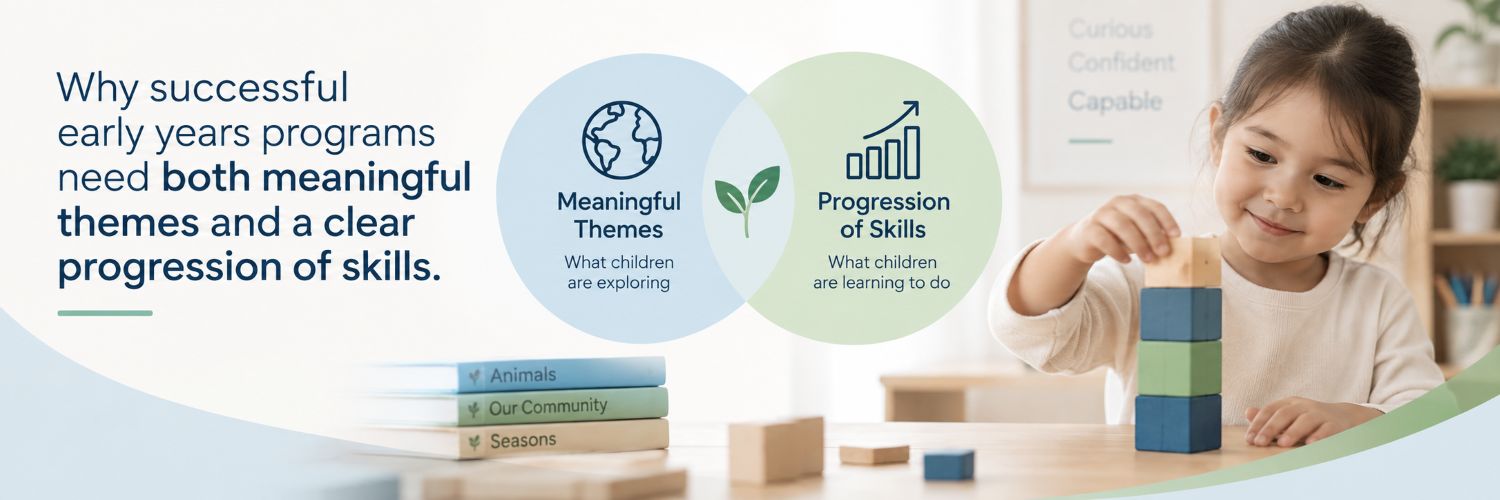
Why successful early years programs need both meaningful themes and a clear progression of skills.
A thematic preschool curriculum organizes learning around topics such as animals, seasons, families, transportation, or the environment. A skills-based curriculum organizes learning around the developmental and academic skills children need to acquire, such as phonological awareness, vocabulary, counting, number sense, fine motor control, problem-solving, and social-emotional competencies.
The two approaches are not opposites. A strong preschool curriculum can use themes to make learning meaningful while using skills and learning objectives to make progression measurable and consistent.
What Is a Thematic Preschool Curriculum?
Thematic learning organizes activities around a central topic or area of interest. For example, a theme such as Animals could connect storytelling, science, art, vocabulary, counting, movement, and creative play.
A theme such as My Community could combine language development, social-emotional learning, role-play, early numeracy, and discussions about the world around the child.
Thematic learning can make preschool education engaging, integrated, memorable, and connected to children’s real-life experiences.
But there is an important question for teachers and school leaders:
Does completing a theme automatically mean that children have developed the intended skills?
This is where a skills-based approach becomes important.
What Is a Skills-Based Preschool Curriculum?
A skills-based curriculum begins by identifying what a child should be able to know, understand, or do. Lessons and activities are then organized to develop those competencies progressively.
Important preschool skills can include:
- Letter-sound recognition
- Phonological awareness
- Listening and speaking
- Vocabulary development
- Emergent reading and writing
- Counting
- Number recognition
- Patterns
- Comparing quantities
- Spatial reasoning
- Fine and gross motor development
- Problem-solving
- Cooperation and emotional regulation
In a skills-based curriculum, activities are not simply selected because they are interesting. They are connected to specific learning objectives and developmental outcomes.
The Key Difference: Context vs Progression
The difference between thematic and skills-based learning can be summarized quite simply:
| Thematic Curriculum | Skills-Based Curriculum |
|---|---|
| Begins with a topic | Begins with a learning objective |
| Asks: “What are we learning about?” | Asks: “What skill are we developing?” |
| Creates context and engagement | Creates progression and continuity |
| Integrates subjects naturally | Tracks specific competencies |
| Activities may vary significantly by teacher | Learning objectives remain consistent |
Themes help answer what children are exploring. Skills help answer what children are learning to do.
Why Skills Matter in Early Literacy and Numeracy
Early literacy and numeracy require progression.
In literacy, children gradually develop oral language, vocabulary, phonological awareness, print knowledge, phonics, comprehension, and emerging reading and writing skills.
In mathematics, children develop number sense, counting, mathematical vocabulary, patterns, comparison, spatial understanding, and problem-solving. Young learners often progress from concrete experiences with real objects toward pictures and, eventually, more abstract mathematical concepts.
A child can participate enthusiastically in a theme about dinosaurs without necessarily developing phonological awareness or number sense. Those skills require deliberate progression.
Where Thematic-Only Implementation Can Become Difficult
The problem is not thematic learning. Themes can be highly effective.
The challenge arises when themes are used without a sufficiently clear skills progression underneath them.
This can create several difficulties:
- Different teachers may emphasize different skills.
- Attractive activities can become the focus rather than the learning objective.
- Important literacy or numeracy competencies may receive uneven coverage.
- School leaders may find it difficult to determine whether classrooms are progressing consistently.
- Teachers with limited Early Childhood Education experience may struggle to translate broad themes into specific developmental objectives.
Flexibility without structure can become inconsistency; structure without flexibility can become rigidity. Liberty provides both.
The Strongest Model: Skills as the Backbone, Themes as the Context
Preschools do not have to choose between thematic learning and skills-based learning.
A strong preschool curriculum can establish clear learning objectives and a developmental sequence while still incorporating:
- Stories and books
- Play-based learning
- Hands-on activities
- Thematic exploration
- STEAM
- Creative arts
- Music and movement
- Social-emotional learning
- Real-world experiences
The important distinction is that the activity supports the learning objective rather than replacing it.
The theme should enrich the learning. It should not replace the learning progression.
What Does This Look Like in a Real Preschool Classroom?
Consider a classroom exploring an Animals theme.
The teacher might read an animal story, ask children to imitate animal movements, draw animals, sort animals into groups, or match animals with their habitats.
Underneath those activities, however, there can be clearly defined skills:
- Literacy: identify beginning sounds and develop new vocabulary.
- Numeracy: count animals and compare quantities.
- Cognitive development: classify animals according to characteristics.
- Physical development: imitate different animal movements.
- Social-emotional learning: discuss caring for animals and living things.
The teacher remains free to change the animals, story, materials, or discussion according to the interests, language, and culture of the classroom.
The learning objectives remain clear.
Why Books Can Strengthen a Skills-Based Preschool Curriculum
Well-designed preschool books can provide a visible sequence of learning rather than leaving curriculum progression entirely to individual teachers.
Liberty Education’s preschool curriculum uses three levels of carefully developed books supported by Teacher Guides that follow the books page by page.
The books provide progression. The Teacher Guides connect each section to learning objectives, activities, and supporting resources.
This structure is especially valuable in schools where teachers may have different levels of Early Childhood Education training or experience.
The books create continuity; the teacher creates the classroom experience.
What Should School Leaders Look for in a Preschool Curriculum?
When comparing preschool curricula, principals, owners, and academic directors should consider several practical questions:
- Are literacy and numeracy skills explicitly sequenced?
- Are learning objectives clear?
- Can teachers explain what skill each activity is intended to develop?
- Can themes and activities be adapted without losing the learning objective?
- Does the curriculum support teachers with different levels of ECE experience?
- Can administrators maintain consistency across multiple classrooms?
- Can the curriculum work with different languages, cultures, and teaching methodologies?
- Can the program scale from one classroom to multiple schools or an education system?
Thematic or Skills-Based? Strong Preschool Programs Can Use Both
Thematic and skills-based learning do not have to compete.
Themes can make preschool learning engaging, meaningful, and connected to the child’s world. A skills-based structure helps ensure that engagement results in measurable developmental and academic progress.
For many schools, the strongest model is one in which skills provide the backbone and themes provide the context.
Liberty Education follows this approach through structured preschool books, clear learning objectives, page-by-page teacher guidance, and flexible classroom activities centered on early literacy, early numeracy, and whole-child development.
A strong preschool curriculum should not only describe what good early learning looks like. It should make good early learning possible in the real classroom.